Two-Layer Milk Barfi
दूध की बर्फी
By Geeta S · 55 min · serves 8
Cook mode, timers and a grocery list — get the Zaika app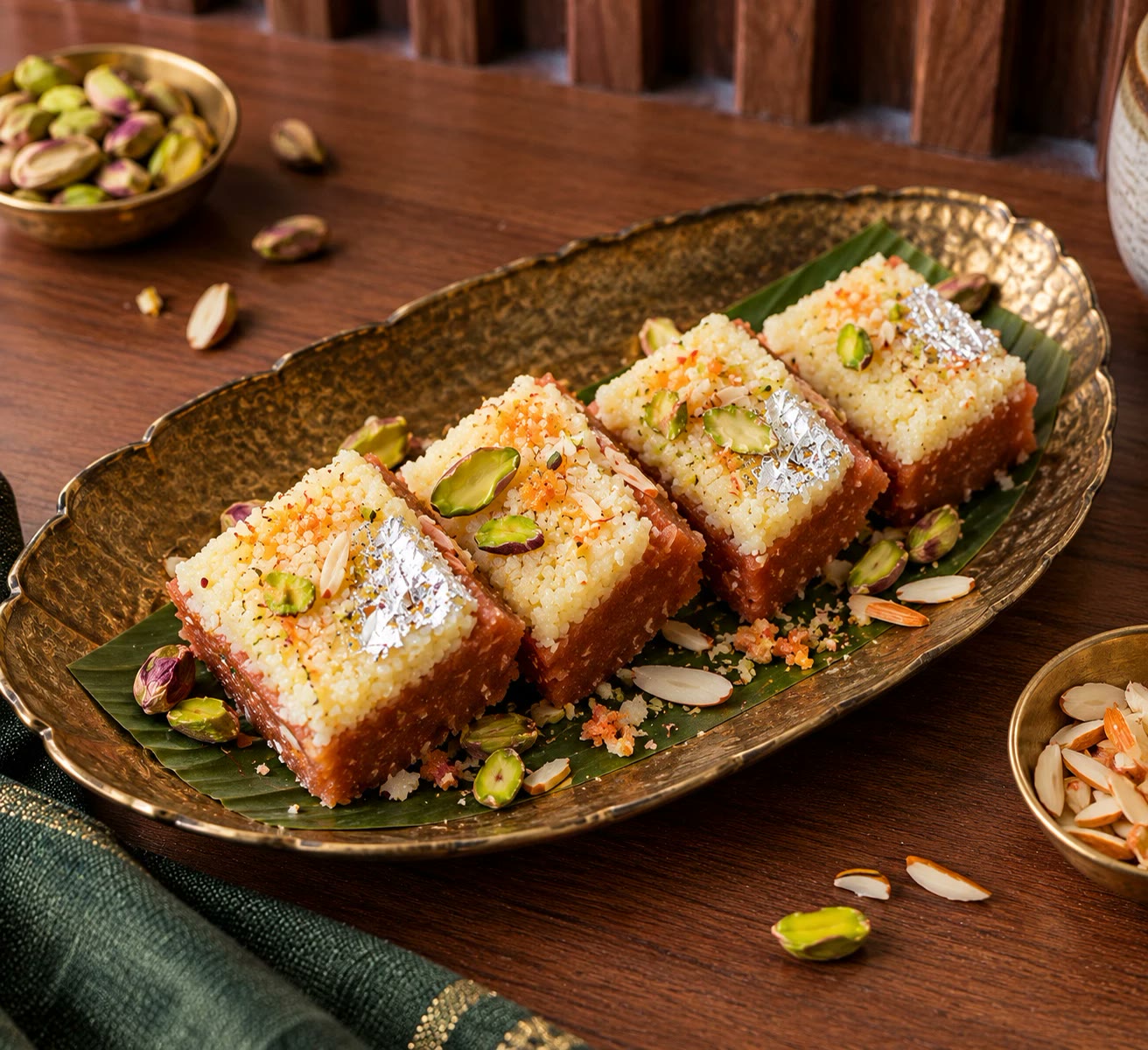
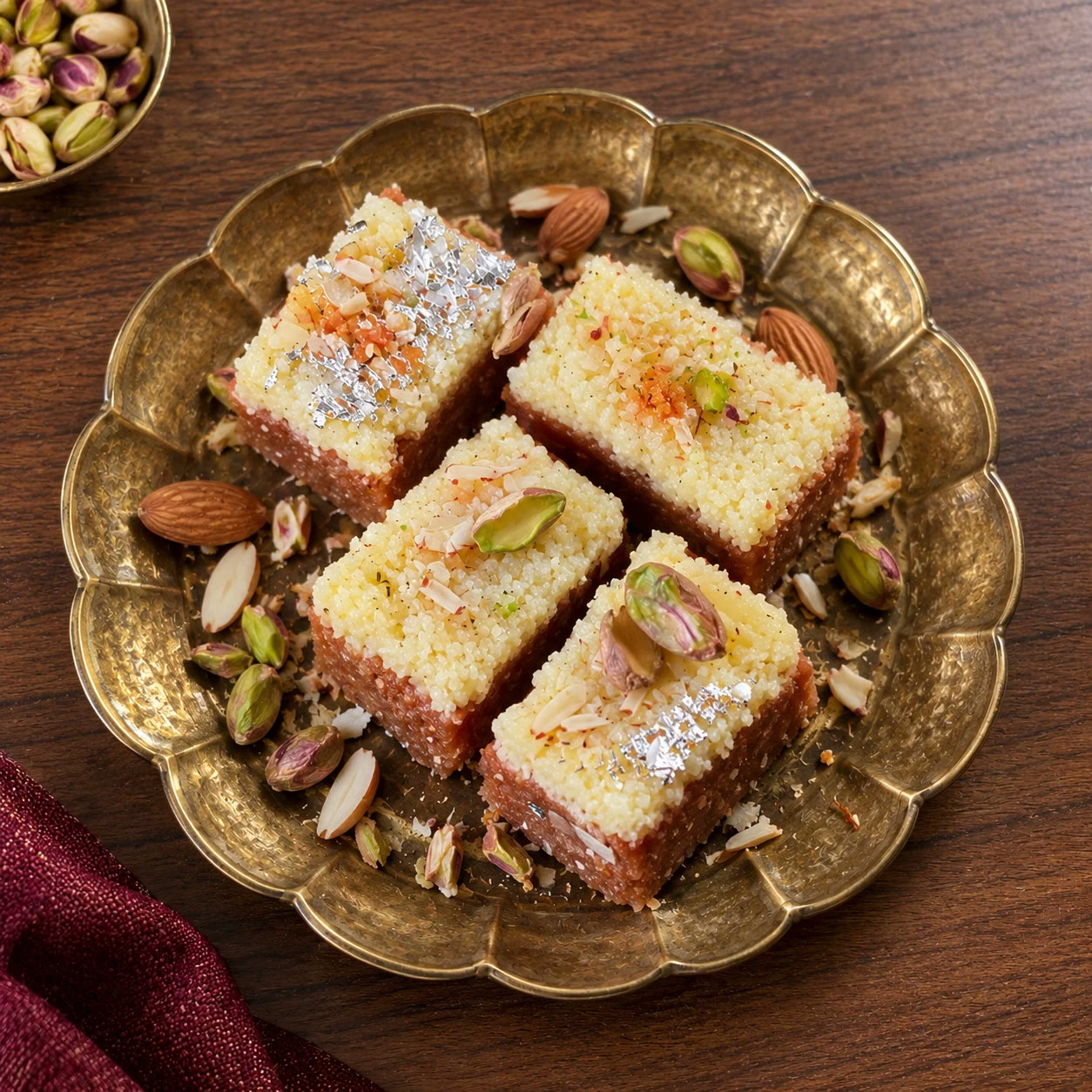
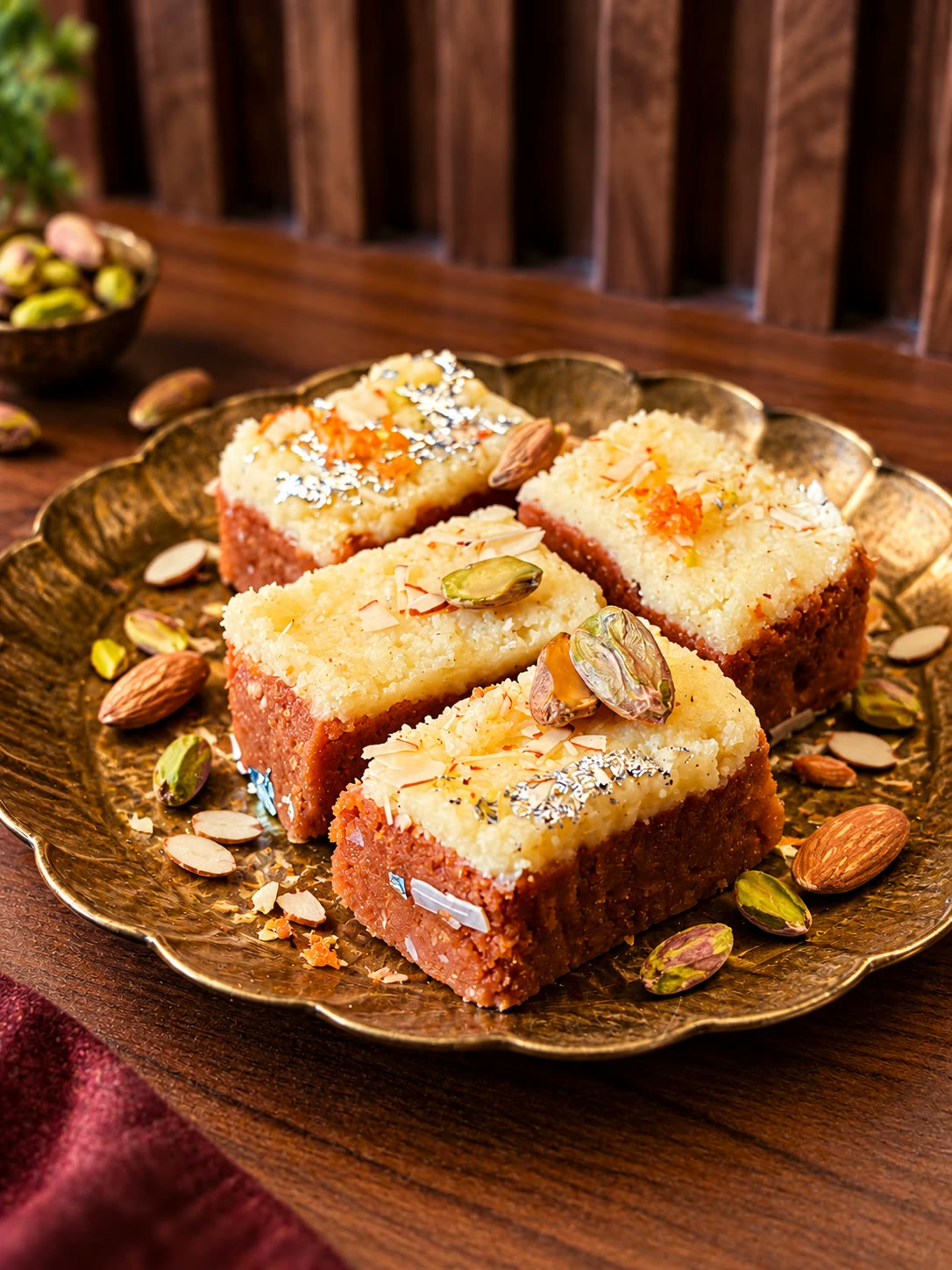
A milk barfi in two flavours, pressed in two layers: saffron below, cardamom above, both with the coarse grain of fresh chhena rather than the smooth paste of a milk-powder sweet. Beyond the prep and cook times the tin needs two or three hours on the counter to set before it will cut cleanly, so it is a morning sweet for the evening, or the day before. The grain is the point, and the method is built to keep it. The depth of orange in the lower layer comes from a drop of kesar colour alongside the saffron; saffron alone gives a paler gold, and that is fine too. Silver leaf, pistachio and almond and a few saffron threads go on top. This is Geeta’s sweet and her photographs; the write-up is Zaika’s, checked against them.
Ingredients
- 2 litres whole milk, pasteurised but not ultra-pasteurised8 cups whole milk, pasteurised but not ultra-pasteurisedIn the US: The carton matters: ultra-pasteurised milk has been heated so hard that it splits into a weak, mealy chhena that will not hold a grain. Store-brand whole milk that says only pasteurised, a local dairy, or an Indian grocery. A 15 oz tub of whole-milk ricotta, or a 14 oz block of store-bought paneer, stands in for the chhena from two litres — see the substitutions note.
- 3 tbsp lemon juice, mixed with 3 tbsp water3 tbsp lemon juice, mixed with 3 tbsp waterIn the US: Two tablespoons of white vinegar in the same amount of water.
- 200 g sugar1 cup sugar
- 50 g full-fat milk powder⅓ cup full-fat milk powderIn the US: Nido from the Hispanic aisle of a US supermarket, or full cream milk powder from an Indian grocery. Without it the barfi is softer and needs five minutes more in the pan; it still sets.
- 2 tbsp ghee, plus a little for greasing2 tbsp ghee, plus a little for greasing
- A generous pinch of saffron strands, about 25, soaked in 1 tbsp warm milk taken from the 2 litres, plus a few dry threads to topA generous pinch of saffron strands, about 25, soaked in 1 tbsp warm milk taken from the 2 litres, plus a few dry threads to top
- 1 drop kesar (orange) food colour, or a knife-tip of the powder1 drop kesar (orange) food colour, or a knife-tip of the powderIn the US: Indian groceries mostly sell kesari colour as a powder in small tubs. Use only what clings to the tip of a knife, since the powder is far stronger than a drop of liquid. Leave it out and the lower layer is a soft saffron gold rather than orange; the flavour is the same.
- ½ tsp cardamom powder½ tsp cardamom powder
- 1 tbsp pistachios, halved or slivered, to top1 tbsp pistachios, halved or slivered, to top
- 1 tbsp slivered almonds, to top1 tbsp slivered almonds, to top
- Silver leaf (varq), to finish — optionalSilver leaf (varq), to finish — optionalIn the US: There is no substitute, and the barfi is complete without it. Buy it at an Indian grocer, where it comes between sheets of tissue, and not at a craft shop, where silver leaf is usually aluminium and is not food. Varq was traditionally beaten between layers of ox gut, which is why some vegetarians avoid it; look for a pack that says machine-made.
Method
- 1Take 1 tbsp of the milk, warm it, and leave the saffron to soak in it. Grease a 12 cm square tin or a 10 × 15 cm loaf tin with ghee and line it with parchment that overhangs two sides, so the set barfi can be lifted out without being turned over. Bring the rest of the milk to a boil in the widest, heaviest pan you have, turn off the heat, wait a minute, and stir in the diluted lemon juice a spoon at a time until the milk splits into soft curds and a clear, greenish whey. Stop adding acid the moment it does.10 min
- 2Pour it through a muslin-lined sieve, run cold water through the muslin for a minute to rinse out the lemon, and squeeze gently. Leave the bundle in the sieve for ten minutes and no longer: this chhena should stay damp, because moist chhena cooks into coarse, separate grains and a dry, hung one crumbles into sand.10 min
- 3Wipe out the pan, crumble the chhena into it with the sugar and set it over medium heat. Within two or three minutes the sugar melts and the mixture goes loose and wet, which is normal. Stir slowly and steadily, scraping the base, until the liquid has cooked away and the grains stand out again in a thick mass, ten to twelve minutes. Stir, do not beat: hard stirring breaks the grains down into paste.12 min
- 4Add the ghee and the milk powder and keep stirring on medium-low until the mass gathers into one lump that leaves the sides of the pan, and a spoon dragged through it leaves a trail that stays open. Cool a pea-sized piece for a few seconds and roll it: a soft ball that does not stick to your fingers means it is done. Take the pan off the heat.8 min
- 5Working quickly while it is hot, divide the mass in half. Stir the saffron milk and the drop of colour into one half until the colour is even, and the cardamom into the other. Press the saffron half into the tin in a level layer about a centimetre and a half deep, then spread the cardamom half over it and press it down firmly with a sheet of greased parchment so the two layers bond. If the second half has stiffened while you worked, a minute back in the warm pan softens it.5 min
- 6Scatter the pistachios, the almond slivers and the dry saffron threads over the top and press them in while it is warm; lay the silver leaf on last, straight from its paper, if you are using it. Leave the tin on the counter until it is cool all the way through and firm to the touch, two to three hours. Lift it out by the parchment, the right way up, and cut it into sixteen pieces about 3 cm across with a greased knife wiped between cuts, so the cream layer stays clean over the orange one; a serving is two pieces. Keep them in an airtight box in the fridge, parchment between the layers, for up to five days.150 min
Prefer to cook in Hindi, Tamil, Bengali or another language? Save this into the Zaika app and the method reads in yours.
If it goes wrong
Why your milk barfi will not set, crumbles, or comes apart at the layers
Still soft and tacky after three hours means the chhena had not given up its water when the pan came off the heat. It can be rescued: scrape it all back into the pan and cook until the ball test passes, then press it again. The two layers will have blended into one colour, and it is still a good barfi. Crumbling at the knife is the opposite, overcooked or made from chhena hung until it was dry; work in a spoonful of warm milk while the mass is still warm. The layers coming apart when cut means the second was pressed onto a first that had already cooled and skinned over: both halves must be hot, and the top one pressed down hard. A smooth paste with no grain comes from fast, hard stirring or a high flame; the grain survives only when the pan is stirred, not beaten.
Substitutions
Milk, milk powder, colour, ricotta or paneer: making milk barfi in the US
Plain pasteurised whole milk, from a store brand, a local dairy or the Indian grocery, because ultra-pasteurised milk curdles into mealy, weak chhena. Full-fat milk powder is Nido in the Hispanic aisle or full cream milk powder from an Indian grocery; non-fat dry milk makes a chalkier barfi. The orange of the lower layer is kesar food colour, sold at any Indian grocery, mostly as a powder in small tubs and sometimes as a liquid; saffron alone gives a soft gold, which is the honest colour and perfectly good. The real shortcut is ricotta: a 15 oz tub of whole-milk ricotta, drained in a sieve for half an hour, replaces the chhena from two litres of milk and skips the curdling altogether. It holds more water, so the sugar stage takes ten minutes longer, and the grain comes out a little finer. Store-bought paneer works too, though it is pressed and drier than fresh chhena: grate a 14 oz block finely, loosen it with three or four tablespoons of milk, and expect a finer, denser grain. For a rose layer in place of the saffron, stir a tablespoon of rose syrup into the half that would have taken the saffron and leave out the colour; for pistachio, two tablespoons of finely ground pistachios.
Substitutions
Is two-layer milk barfi gluten-free, egg-free or nut-free?
There is no flour or egg in it, so it is gluten-free and egg-free as written, and it is not vegan: chhena, milk powder and ghee are all milk. It contains no nuts if you leave off the pistachio and almond finish, and skip the pistachio-layer variation, which is nuts all through; check the milk powder, cardamom and food-colour packs for a may-contain warning before you give it to someone with a nut allergy. If you use silver leaf and cook for vegetarians, choose machine-made varq.
Keeping it
How long milk barfi keeps, and why it lives in the fridge
This is a fresh-cheese sweet and it belongs in the fridge: five days in an airtight box with parchment between the layers of pieces. It is at its best from the second day, once the two halves have settled into each other. Chilled chhena is firm and quiet, so let the pieces come up on the counter for a quarter of an hour before serving. It freezes for a month, wrapped in parchment and then foil, and thaws overnight in the fridge; thawed on the counter, the surface sweats and the silver leaf lifts.
Make ahead
How far ahead to make two-layer barfi for a Diwali box
Make it two days before the day and keep it in the fridge until you pack. Cut it small, about 3 cm a piece, because two layers of chhena barfi are richer than they look, and set each piece so a cut face shows both layers. One tin gives sixteen pieces. Pack it on the day, in a layer of its own: it is a moist fridge sweet, and kaju katli packed against it goes soft. The whole batch pressed as a single layer with the saffron and colour in it is the kesar barfi of the shops.
Nutrition
Estimated, per serving.
- Calories
- 280
- Protein
- 9 g
- Carbs
- 29 g
- Fat
- 14 g
- Sugar
- 28 g
- Sodium
- 60 mg
This recipe is ready for the Zaika app
Step timers on the method, the whole thing readable in your own language, and the ingredients on a grocery list split by the shops you actually use. Zaika is free on iPhone and Android.