Motichoor Ladoo
मोतीचूर लड्डू
By Geeta S · 55 min · serves 14
Cook mode, timers and a grocery list — get the Zaika app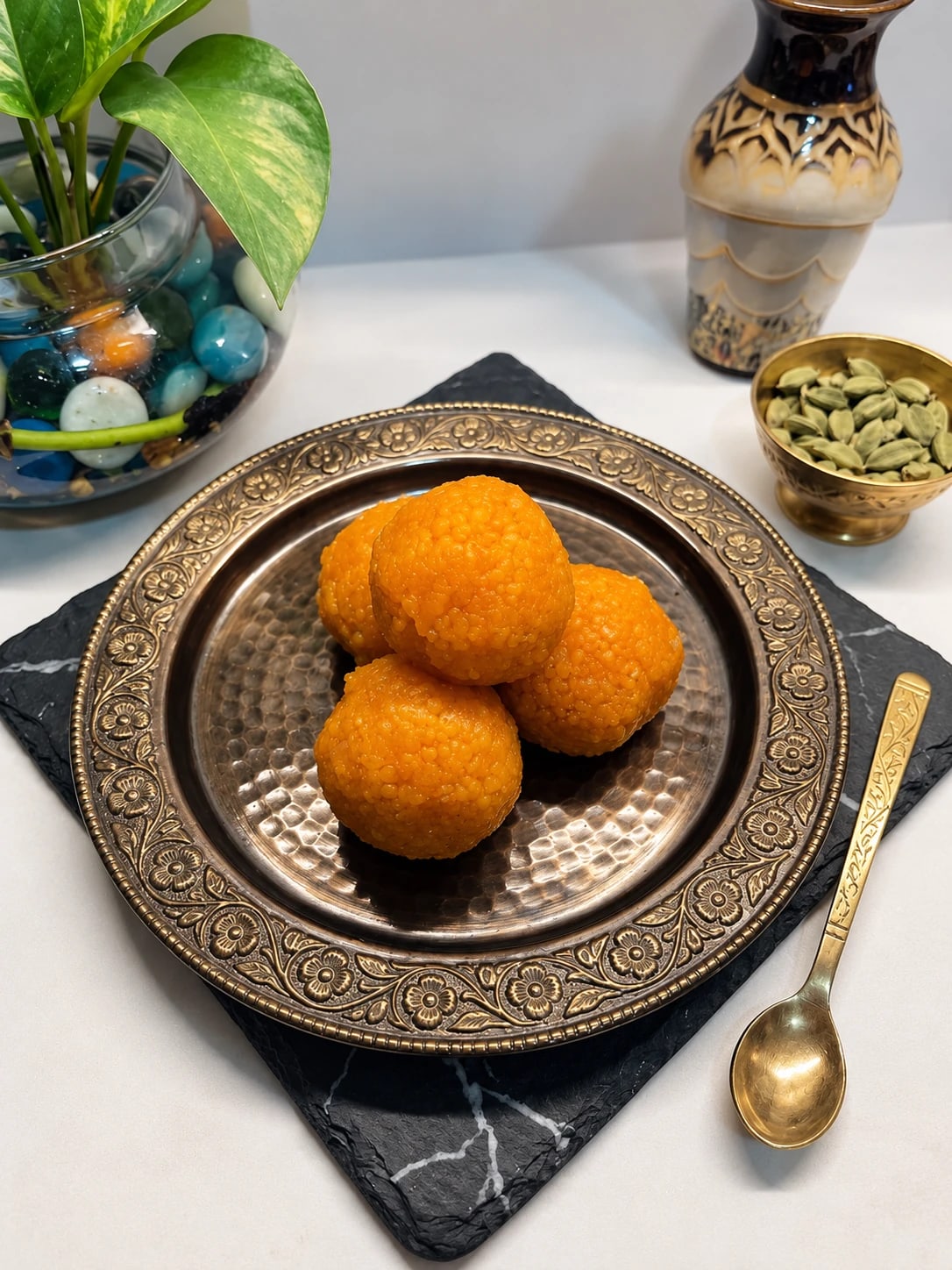
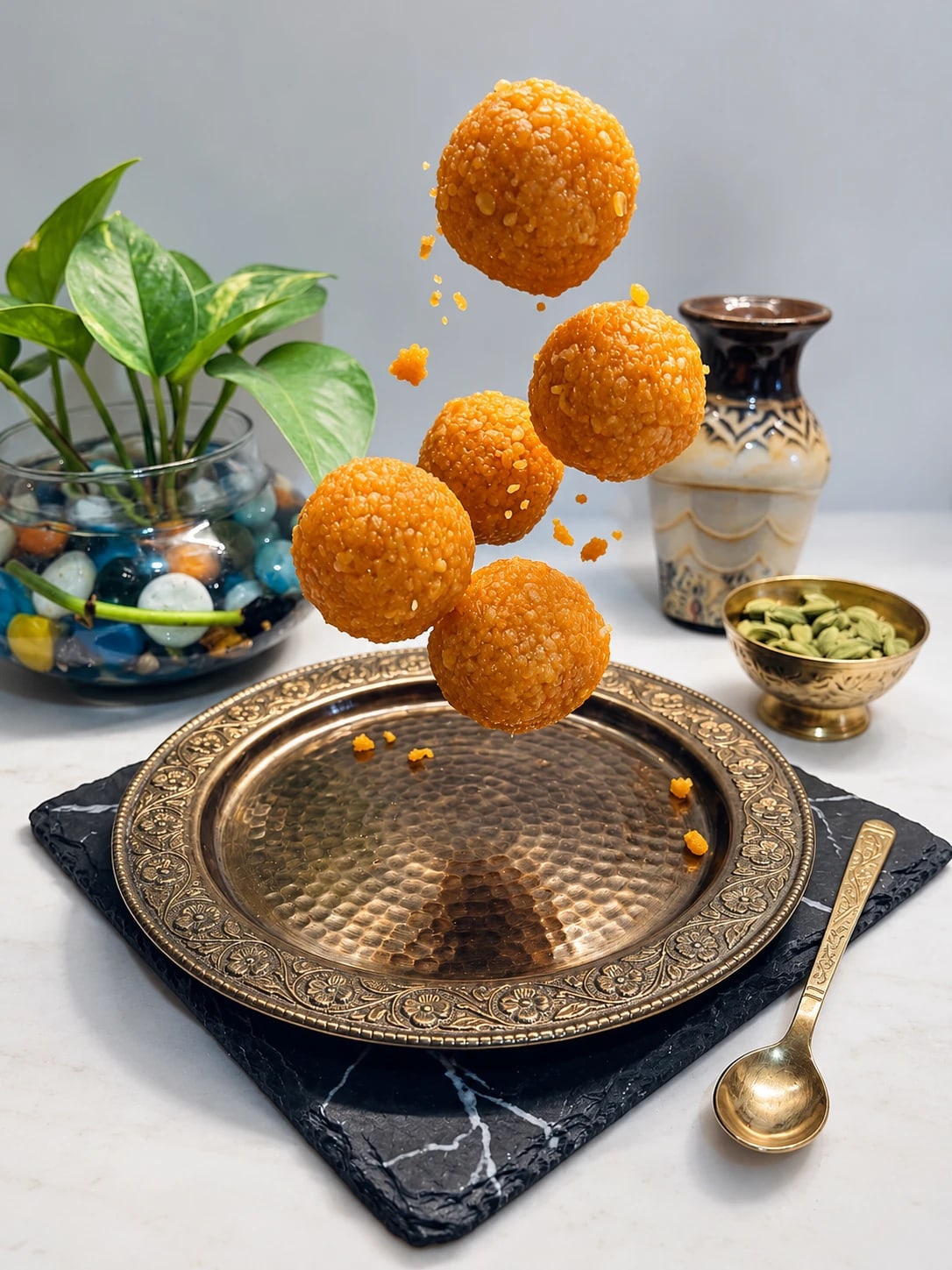
Motichoor ladoo is made from the finest boondi there is: pearls of gram-flour batter barely bigger than a mustard seed, fried, soaked in saffron and cardamom syrup, partly crushed and pressed into balls while warm. Allow about an hour and twenty minutes from the first whisk to the last ladoo, since the prep and cook times leave out the ten minutes the batter rests and the twenty the pearls spend soaking. The difficulty sits in one place: the pearls have to be tiny, which takes a thin batter and a fine ladle held low over the ghee, and they have to come out before they darken, because pearls that brown never soften and you feel every one. The syrup wants stickiness and no thread; boiled to one string it makes a firmer, drier ladoo, and past that a hard one. This is Geeta’s sweet and her photographs; the write-up is Zaika’s, checked against them.
Ingredients
- 180 g besan (gram flour), fine1½ cups, scooped besan (gram flour), fineIn the US: The chickpea flour in US supermarkets (Bob’s Red Mill garbanzo bean flour is the usual one) is milled from a different chickpea and is a little coarser, so the pearls come out less smooth. Sift it twice and give the batter its full ten minutes. Avoid the garbanzo-fava blend, which has a stronger bean flavour.
- 2 tbsp besan, kept separate, to thicken the batter if it needs it2 tbsp besan, kept separate, to thicken the batter if it needs it
- 250 ml water, for the batter, plus a spoonful or two to adjust1 cup + 1 tbsp water, for the batter, plus a spoonful or two to adjust
- 1 pinch orange food colour (optional)1 pinch orange food colour (optional)In the US: Indian grocers sell it as kesari colour powder. The liquid colours in a US supermarket make the same orange at two parts yellow to one part red: stir them into the batter water, a few drops at a time, until the water is a strong orange.
- 300 g sugar1½ cups sugar
- 180 ml water, for the syrup¾ cup water, for the syrup
- 1 pinch saffron strands, for the syrup1 pinch saffron strands, for the syrup
- 8 green cardamom pods — 6 seeded and ground for the syrup (about ½ tsp), the rest whole to finish8 green cardamom pods — 6 seeded and ground for the syrup (about ½ tsp), the rest whole to finish
- 2 tbsp melon seeds (optional)2 tbsp melon seeds (optional)In the US: Sold as magaz or char magaz at an Indian grocery. Nothing in a supermarket looks right in their place, so leave them out: they add a little crunch, and the ladoo holds together without them.
- 500 ml ghee or neutral oil, for frying2 cups ghee or neutral oil, for fryingIn the US: A neutral oil such as canola or sunflower fries boondi perfectly well. Ghee gives the sweet-shop aroma, and a half-and-half mix gets most of it.
- 1 tsp ghee, for your palms1 tsp ghee, for your palms
- 1 tbsp pistachios, slivered or chopped, to finish (optional)1 tbsp pistachios, slivered or chopped, to finish (optional)In the US: Shelled unsalted pistachios from any supermarket, sliced thin or chopped with a sharp knife.
- 1 tbsp almonds, slivered, to finish (optional)1 tbsp almonds, slivered, to finish (optional)
- silver varq (edible silver leaf), one sheet, to finish (optional)silver varq (edible silver leaf), one sheet, to finish (optional)In the US: There is no substitute, and the ladoo is complete without it. Buy it at an Indian grocer, where it is sold between sheets of tissue near the checkout, and not at a craft shop, where silver leaf is usually aluminium and is not food. Varq was traditionally beaten between layers of ox gut, which is why some vegetarians avoid it; look for a pack that says machine-made.
Method
- 1Sift the 180 g of besan into a bowl; the 2 tablespoons kept separate are for later. Stir the food colour into the batter water, then add the water to the besan a little at a time, whisking out every lump, until the batter runs off the whisk in a thin, unbroken stream, about as thick as half-and-half and well short of pancake batter. Leave it ten minutes, then whisk again: it thickens as it stands.10 min
- 2Meanwhile, make the syrup in a wide pan that will take all the boondi. Bring the sugar, syrup water and saffron to a boil, then boil gently for five to seven minutes, until a drop left on a plate for ten seconds feels sticky between finger and thumb but pulls no thread as they part. Stir in the ground cardamom and take the pan off the heat: left on even the lowest flame through the frying, it keeps thickening towards the thread, which makes a firmer, drier ladoo. Test from the plate, never straight from the pan, because hot syrup sticks to skin and keeps burning.7 min
- 3Heat the frying ghee in a wide kadhai or a deep frying pan to medium, about 170°C (340°F), with a lid within reach. Test with one drop of batter: it should rise at once and sizzle gently without darkening. If the ghee smokes, it is too hot, and the pearls will brown and harden before you can lift them out.
- 4Hold the motichoor jhara, or the finest perforated ladle you have, about 5 cm (2 in) above the ghee. Pour a spoonful of batter onto it and tap the handle gently so the batter falls through in tiny round drops. Do not press it through, which pulls tails. If the first drops have tails, add a spoonful of water to the batter; if they spread into flat discs, whisk in a spoonful of the besan you kept separate.
- 5Fry each batch for twenty to thirty seconds, just until the sizzling quietens and the pearls are set but not darkened (still bright orange, or pale yellow if you left the colour out), and lift them out before they crisp. Drain for a few seconds and tip them into the syrup, stirring them under. Scrape the underside of the ladle clean between batches; batter dries in the holes and the next drops come out uneven. The whole batter takes about twenty-five minutes. If the syrup has stiffened by the last batches, warm it for a few seconds and stir, and if it now pulls a thread, stir in a tablespoon or two of hot water.25 min
- 6When the last batch is in, stir in the melon seeds, cover the pan, still off the heat, and leave it for twenty minutes, stirring once, until the pearls have drunk up the syrup and look plump and glossy, with no pool left in the bottom.20 min
- 7Take out about a third of the mixture and pulse it two or three times in a food processor, or press it hard with the back of a ladle, so the pearls break; stir it back in. The crushed pearls are what hold the ladoo together, and they are the name: motichoor means crushed pearls.
- 8Grease your palms with the teaspoon of ghee. While the mixture is still warm, take about 50 g (a heaped quarter cup), press it firmly between your palms into a ball, then roll it smooth; this makes about 14 ladoos. If the mixture crumbles, sprinkle a teaspoon of hot water over it and press again. Set the ladoos on a plate, uncovered; they firm up as they cool, and are ready to stack once they have.
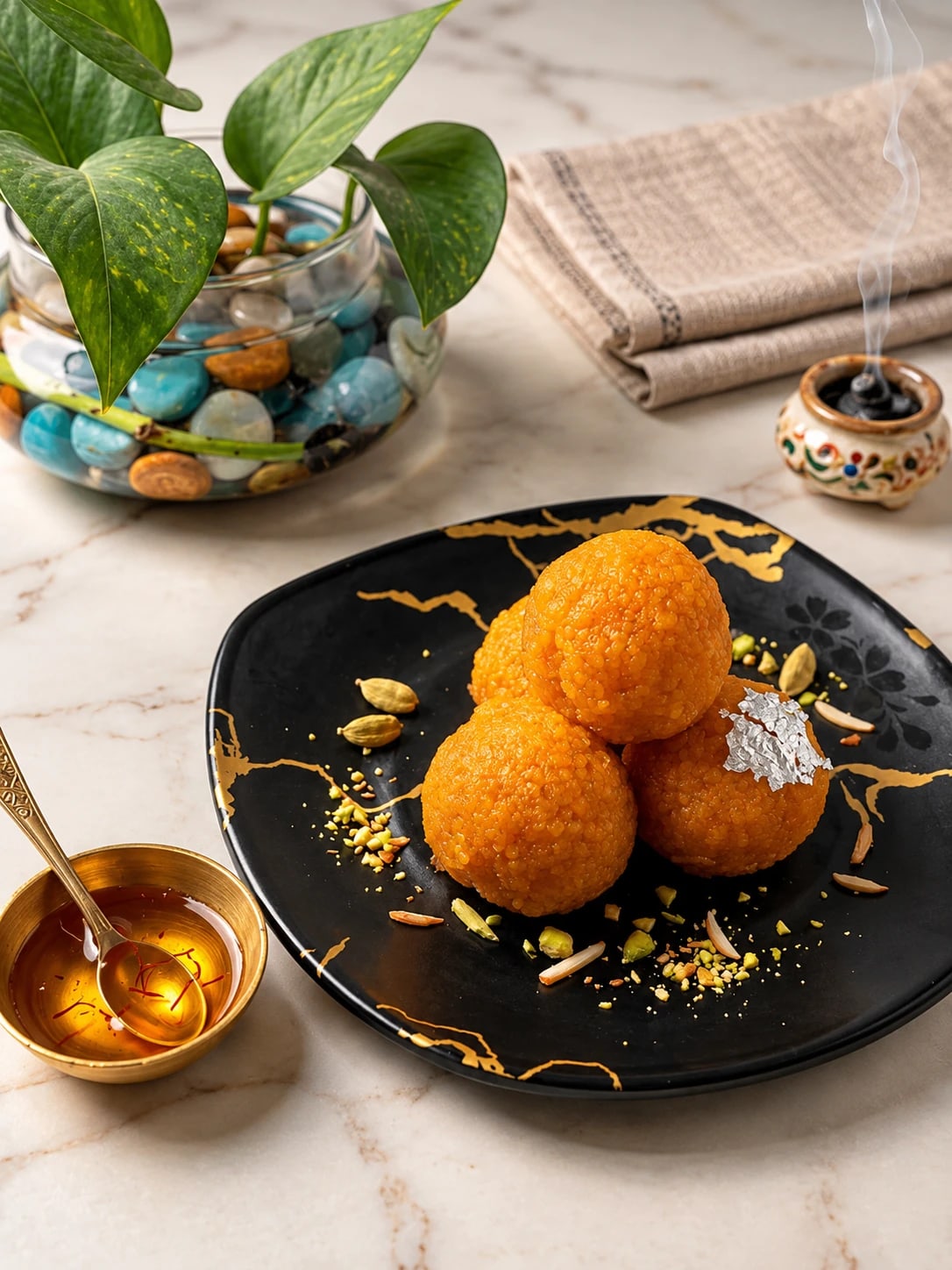
- 9Serve them plain. For a festival plate, lay a small piece of silver varq on one or two ladoos and scatter the pistachios, almonds and whole cardamom pods around them.
Prefer to cook in Hindi, Tamil, Bengali or another language? Save this into the Zaika app and the method reads in yours.
If it goes wrong
Why your boondi has tails, or comes out flat
Tails mean the batter is too thick, or that it is being pushed through the ladle instead of falling: thin it with a spoonful of water and tap the handle rather than pressing. Flat drops that spread mean it is too thin, so whisk in a spoonful of the besan you kept separate. Drops that sink and stick to the bottom mean the ghee is not hot enough yet. Fry a test batch of a dozen drops after every adjustment, and expect to adjust again halfway through, because the batter keeps thickening as it stands.
If it goes wrong
Why your motichoor ladoo will not hold its shape
Almost always one of three things. The mixture has gone cold, and it binds only warm: warm it in a pan over low heat for a minute, stirring, and roll again. Too little of it was crushed, so crush another handful. Or the pearls are wet rather than sticky, which comes from syrup taken off too early or from too little besan for the sugar. Besan spooned into a cup weighs about a quarter less than besan scooped, which is why the list gives grams. Leave a wet mixture uncovered for ten minutes more and try again.
If it goes wrong
How to soften motichoor ladoos that have turned hard
Hard ladoos come from syrup boiled past one string, or from boondi fried crisp. They can be saved. Crumble them into a pan, sprinkle over two or three tablespoons of hot water for a full batch of fourteen, and warm them over low heat, stirring, until the crumbs soften and turn sticky again, then roll them while warm. Rescued ladoos are moister than the first time and keep only two or three days. Next time, take the syrup off sooner and lift the pearls out before they colour.
Equipment
Motichoor ladoo vs boondi ladoo, and what to use without a jhara
The two differ mostly in the size of the pearl, and the ladle decides it. A motichoor jhara has holes of one to two millimetres; Indian grocers and Amazon sell them for a few dollars, often labelled boondi jhara, so check the holes, because most are made for the bigger boondi. A flat perforated skimmer with small round holes is the closest kitchen-drawer substitute. A slotted spoon makes pearls the size of peas, and what you roll from them is a boondi ladoo: it still binds, but it is coarser than motichoor.
Substitutions
Can you make motichoor ladoo with store-bought boondi?
Not with the packets on the snack shelf of an Indian grocery. That boondi is salted, often spiced, and fried crisp for raita and chaat, so it will not soften in syrup and the ladoo tastes of salt. The pearls have to be fried soft and go into the syrup warm, which is why this recipe makes its own.
Substitutions
What makes motichoor ladoo orange, and whether you can leave the colour out
The orange in the photographs comes from a pinch of food colour in the batter, the way sweet shops make it. The saffron in the syrup perfumes it and adds a little colour, but on its own gives a pale gold. Leave the colour out entirely and the ladoo is the natural yellow of fried besan, and tastes exactly the same.
Substitutions
Is motichoor ladoo gluten-free, vegan or nut-free?
Besan is ground chickpeas and contains no wheat, but some brands are milled alongside wheat flour, so if gluten matters, buy chickpea flour labelled gluten-free. The ladoo is vegan if you fry in a neutral oil, oil your palms instead of using ghee, and use machine-made varq or none. It contains no nuts if you leave off the pistachio and almond finish, but check the besan and melon-seed packs for a may-contain warning before you give the ladoos to someone with an allergy. Melon seeds are seeds, not nuts.
Make ahead
How far ahead you can make motichoor ladoo for Diwali
They keep for about a week in an airtight container at room temperature and two weeks in the fridge. Bring chilled ones back to room temperature before serving, because cold ghee makes them taste waxy. Making them two or three days ahead is common and they are none the worse for it. Add the varq on the day: stored, it dulls and rubs off.
Serving
Motichoor ladoo for Ganesh Chaturthi and Diwali
In much of North India motichoor ladoo is held to be Ganesha’s favourite sweet, and it is offered alongside modak on Ganesh Chaturthi. At Diwali it fills the sweet boxes carried from house to house, and it is the ladoo of weddings and good news.
Nutrition
Estimated, per serving.
- Calories
- 200
- Protein
- 3 g
- Carbs
- 29 g
- Fat
- 8 g
- Fibre
- 2 g
- Sugar
- 23 g
This recipe is ready for the Zaika app
Step timers on the method, the whole thing readable in your own language, and the ingredients on a grocery list split by the shops you actually use. Zaika is free on iPhone and Android.