Malai Chop
মালাই চপ
By Geeta S · 65 min · serves 8 · Bengali
Cook mode, timers and a grocery list — get the Zaika app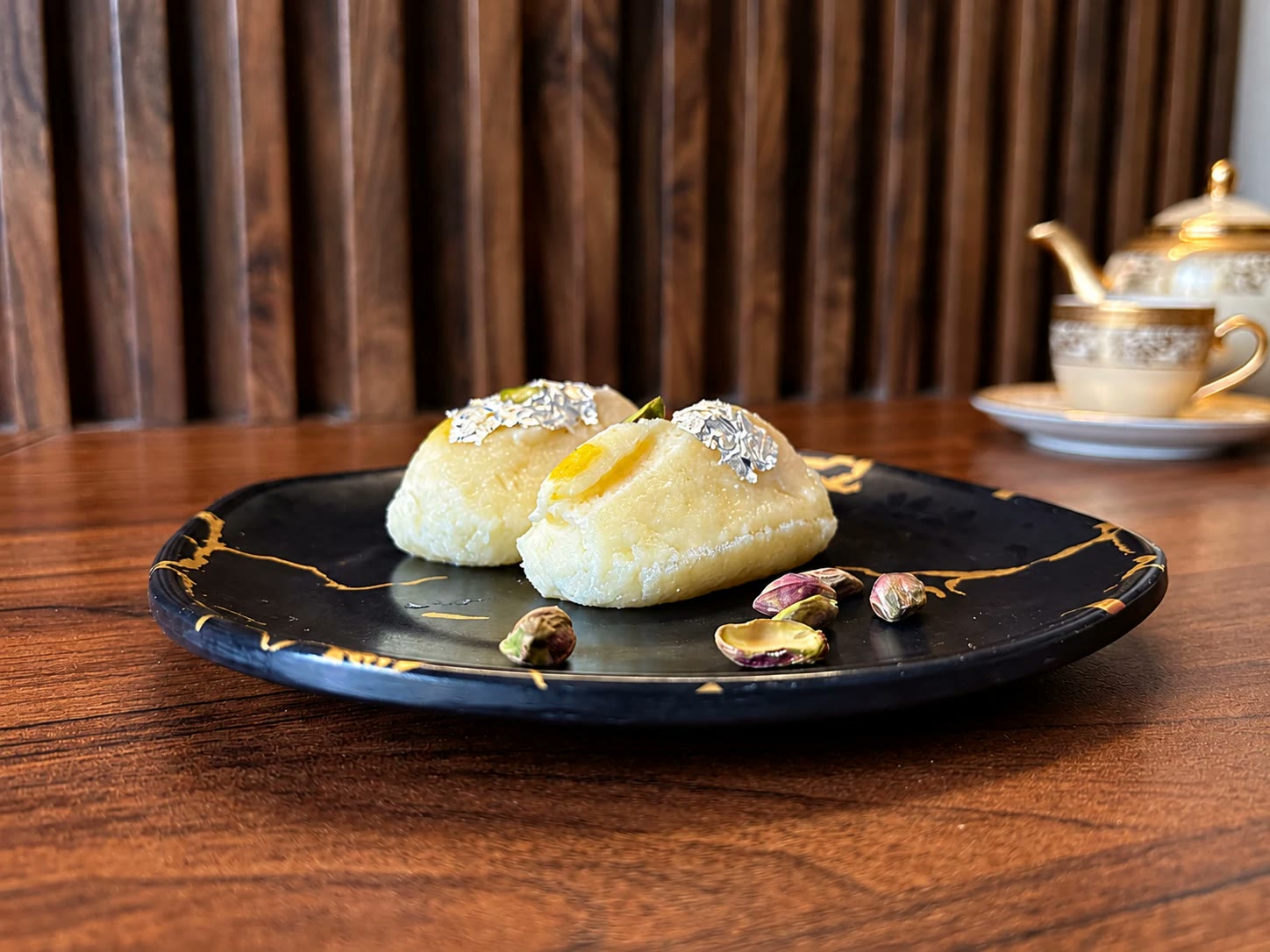
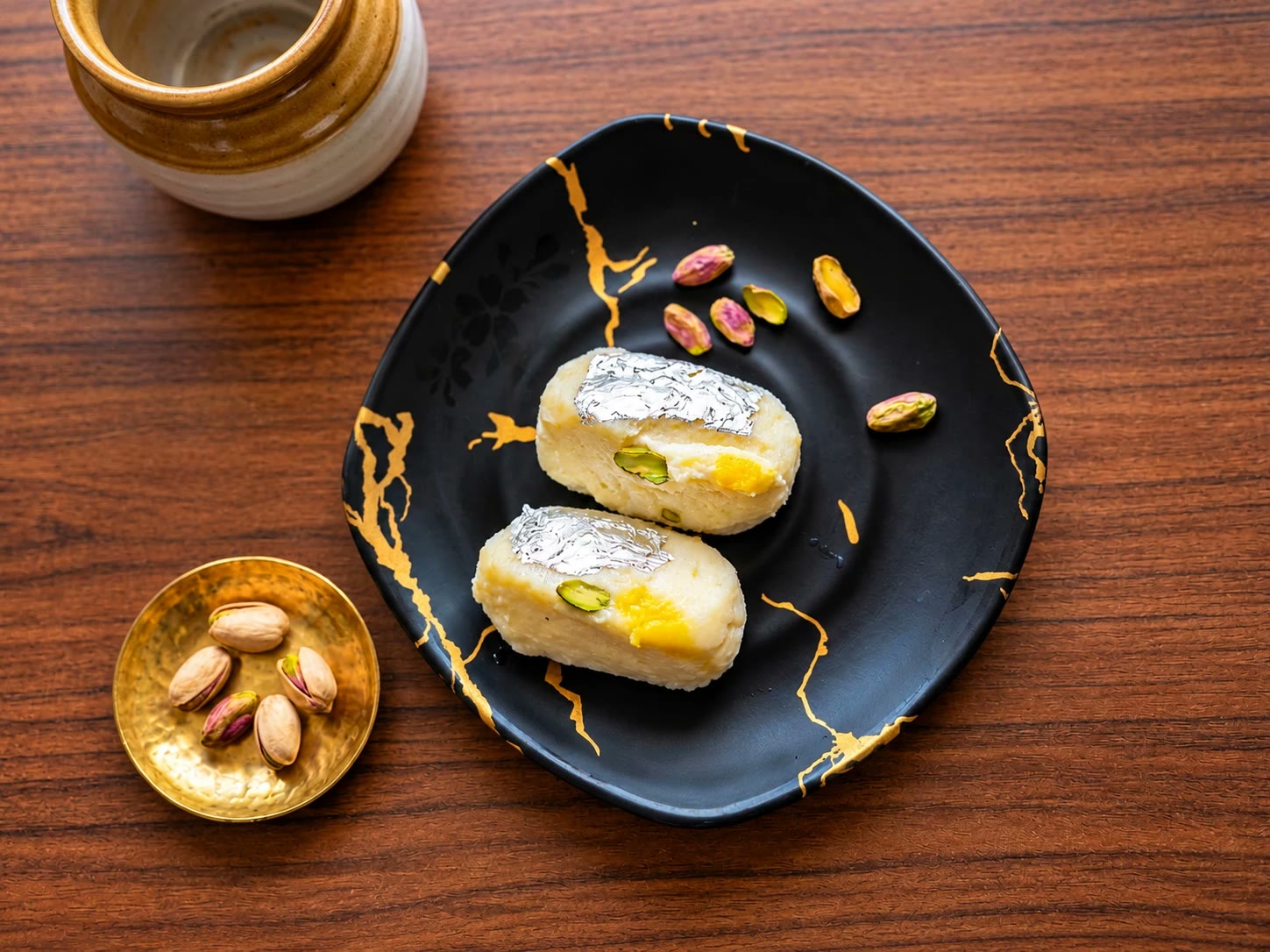
The Bengali sweet that takes a rasgulla one step further: the same fresh chhena, shaped into ovals rather than balls, boiled in a thin syrup until they swell, then moved out of the syrup into milk thickened with saffron and cardamom, where they drink the cream instead. Beyond the prep and cook times there is a half-hour hang for the chhena, a quarter-hour rest in the syrup, about half an hour for the pan of malai to cool and at least two hours in the fridge, so it is an afternoon’s work for the evening. It makes eight, and one is a serving. Each piece is lifted out onto a plate rather than served in a bowl, with a spoon of the thickest malai, a pistachio sliver and, if you have it, a square of silver leaf on top. This is Geeta’s sweet and her photographs; the write-up is Zaika’s, checked against them.
Ingredients
- 1 litre whole milk, for the chhena, pasteurised but not ultra-pasteurised4 cups whole milk, for the chhena, pasteurised but not ultra-pasteurisedIn the US: Read the carton. Milk labelled ultra-pasteurised or UHT gives a chhena that will not knead smooth and falls apart in the syrup, and that covers most organic, lactose-free and ultra-filtered whole milk. Ordinary gallon jugs of conventional whole milk are usually plain pasteurised, as is most milk from local dairies; look for the word pasteurised on its own, wherever you shop. There is no substitute for the right milk in this line; the litre for the malai can be any whole milk.
- 2 tbsp lemon juice, mixed with 2 tbsp water2 tbsp lemon juice, mixed with 2 tbsp waterIn the US: One and a half to two tablespoons of white vinegar mixed with an equal amount of water, added the same way, a spoon at a time; you may not need all of it. The rinse in step two takes the taste away either way.
- 200 g sugar, for the syrup1 cup sugar, for the syrup
- 1 litre water, for the syrup4 cups water, for the syrup
- 1 litre whole milk, for the malai4 cups whole milk, for the malaiIn the US: Any whole milk, ultra-pasteurised included: it is being reduced, not curdled. A 12 oz can of evaporated milk topped up with a cup of whole milk and simmered for ten minutes gets most of the way in a quarter of the time; see the substitutions note.
- 4 tbsp sugar, for the malai4 tbsp sugar, for the malai
- A generous pinch of saffron strands, about 20A generous pinch of saffron strands, about 20
- ¼ tsp cardamom powder¼ tsp cardamom powder
- Pistachio slivers, to finishPistachio slivers, to finish
- Silver leaf (varq), to finish — optionalSilver leaf (varq), to finish — optionalIn the US: There is no substitute, and the sweet is complete without it. Buy it at an Indian grocer, where it is sold between sheets of tissue near the checkout, and not at a craft shop, where silver leaf is usually aluminium and is not food. Varq was traditionally beaten between layers of ox gut, which is why some vegetarians avoid it; look for a pack that says machine-made.
Method
- 1Start the malai first, since it takes the longest and asks only for an occasional stir. Pour the litre of milk for the malai — the one that may be ultra-pasteurised — into a wide, heavy pan, bring it to a boil, then keep it at a lively simmer, stirring and scraping the base and sides every few minutes and folding the skin back in, until it has reduced to about a third and coats a spoon like pouring cream. Stir in the four tablespoons of sugar, the saffron and the cardamom for the last five minutes, then take it off the heat. It thickens further as it cools.40 min
- 2While the milk reduces, make the chhena from the plain pasteurised litre. Bring it to a boil in a second pan, turn off the heat, wait a minute, and add the diluted lemon juice a spoon at a time, stirring gently, until the milk splits into soft curds and a clear, greenish whey; you may not need all of it. Pour it through a sieve lined with muslin, a doubled layer of cheesecloth or a nut-milk bag, rinse under cold running water for a minute, squeeze, and hang the bundle or weight it in the sieve for thirty minutes. It is right when a pinch holds together without water seeping out and still crumbles if pushed; a litre of milk gives about 200 g (7 oz) of chhena at that point.35 min
- 3Knead the chhena on a clean counter with the heel of your hand for eight to ten minutes, until it is smooth, without grain, and faintly greasy. Divide it into eight and shape each piece into a smooth oval about 5 cm long and 3 cm wide, rolling the seam closed so there is no crack, because a crack opens in the syrup and the piece splits. They swell to about 7 cm by 4 cm as they cook.10 min
- 4Bring the sugar and the litre of water to a rolling boil in a wide, deep pot, at least 24 cm (9½ in) across and 4 litres (4 qt), so the ovals have room to swell and the syrup room to froth. Thin on purpose: a thick syrup cannot get into the chhena. Lower in the ovals, cover, and boil on high for fifteen to eighteen minutes without stirring; if the syrup froths towards the rim, set the lid ajar rather than turning the heat down, and add a splash of hot water if it starts to thicken. They are done when they have swollen to full size, a cooked piece dropped into a glass of water sinks instead of floating, and one pressed gently with the back of a spoon springs back to its shape.18 min
- 5Turn off the heat and leave them in the syrup for fifteen minutes to settle. Then lift each one out with a slotted spoon and press it gently with the back of a second spoon to squeeze out most of the syrup — not between your palms, because the syrup inside is still hot enough to scald. The pieces need room to drink the milk, and this is the step that makes malai chop rather than a sweet sitting in rabri. Lay them in a single layer in the warm malai, spoon it over them, and keep it at the barest simmer for four or five minutes, turning them once. Take the pan off the heat and let it cool for about half an hour before it goes into the fridge.20 min
- 6Chill for at least two hours, and better overnight; the pieces take up the saffron milk slowly and pick up a little of its colour as they do. To serve, lift each one out onto a plate, spoon a little of the thickest malai from the top of the pan over it, and finish with a pistachio sliver and, if you have it, a small square of silver leaf laid on straight from its paper.120 min
Prefer to cook in Hindi, Tamil, Bengali or another language? Save this into the Zaika app and the method reads in yours.
If it goes wrong
Why your malai chop is hard, cracked, or has not taken up the milk
Hard and rubbery means the chhena was curdled while the milk was still boiling, had too much acid, or was hung until it dried; the pinch test in step two is the whole guard. Cracked or split in the syrup means a seam that was not rolled closed, or pieces crowded into a pot too small for them to swell, so cook them in two batches if yours is narrow. Pale, dense and tasting only of syrup means they were never squeezed before they went into the milk and had nothing left to drink; press each one gently, as the method says. Malai that is thin and watery had too little time in the pan: it should coat the spoon before the pieces go in, and it thickens again as it chills.
Substitutions
The two milks for malai chop in the US, and the evaporated-milk shortcut
The chhena milk is the one that cannot be substituted: plain pasteurised whole milk, because ultra-pasteurised milk curdles into a mealy chhena that falls apart in the syrup. In a US supermarket that rules out most organic, lactose-free and ultra-filtered whole milk; ordinary gallon jugs of conventional whole milk are usually plain pasteurised, as is most local-dairy milk, but read the label wherever you shop. Store-bought paneer and ricotta do not stand in for the chhena either: pressed paneer will not knead smooth and splits in the syrup, and ricotta dissolves in it. The malai milk is the opposite case, since any whole milk reduces, ultra-pasteurised included. If an hour at the stove is not on, a 12 oz can of evaporated milk with a cup of whole milk, simmered for ten minutes with the sugar, saffron and cardamom, comes close to a reduced litre; sweetened condensed milk does not, because it brings its own sugar and leaves the pieces cloying. Saffron is both the flavour and the colour here and there is nothing to swap for it. A quarter teaspoon of rose water stirred in off the heat makes a different sweet, and a good one.
Substitutions
Is malai chop gluten-free, vegan or nut-free?
As written it is gluten-free: chhena, milk, sugar, saffron and cardamom, with no flour. It cannot be made vegan, because the sweet is milk twice over, the curd and the reduced milk it soaks in, and it is not for anyone with a milk allergy. The only nut is the pistachio sliver on top; leave it off for a nut allergy. For a vegetarian table, check the varq: buy a pack that says machine-made, or leave it off.
Keeping it
How long malai chop keeps
Three days in the fridge, in its milk, in a covered box; it is better on the second day than the first, once the saffron has reached the centre. Lift the pieces out only when you serve them, because out of the milk they dry at the surface within an hour. They do not freeze: the chhena weeps and the malai splits on thawing. The leftover malai is rabri in all but name and is worth eating cold on its own.
Serving
Malai chop, chom chom and rasmalai: what the difference is
All three begin as the same kneaded chhena. A chom chom is the oval boiled in syrup, then drained and served dry, often rolled in grated khoya or coconut; rasmalai is the ball pressed flat and soaked in thickened milk; malai chop, as this recipe makes it, is the oval given the rasmalai treatment, so it holds more of the milk than a flat disc and eats as one firm, creamy piece rather than a soft one in a bowl. In Kolkata sweet shops the piece is often split and filled with a thick layer of malai as well; this recipe soaks the whole piece instead. One is a serving, with a cup of tea beside it.
Nutrition
Estimated, per serving.
- Calories
- 180
- Protein
- 7 g
- Carbs
- 20 g
- Fat
- 8 g
- Sugar
- 19 g
- Sodium
- 60 mg
This recipe is ready for the Zaika app
Step timers on the method, the whole thing readable in your own language, and the ingredients on a grocery list split by the shops you actually use. Zaika is free on iPhone and Android.