Kaju Katli
काजू कतली
By Geeta S · 30 min · serves 12
Cook mode, timers and a grocery list — get the Zaika app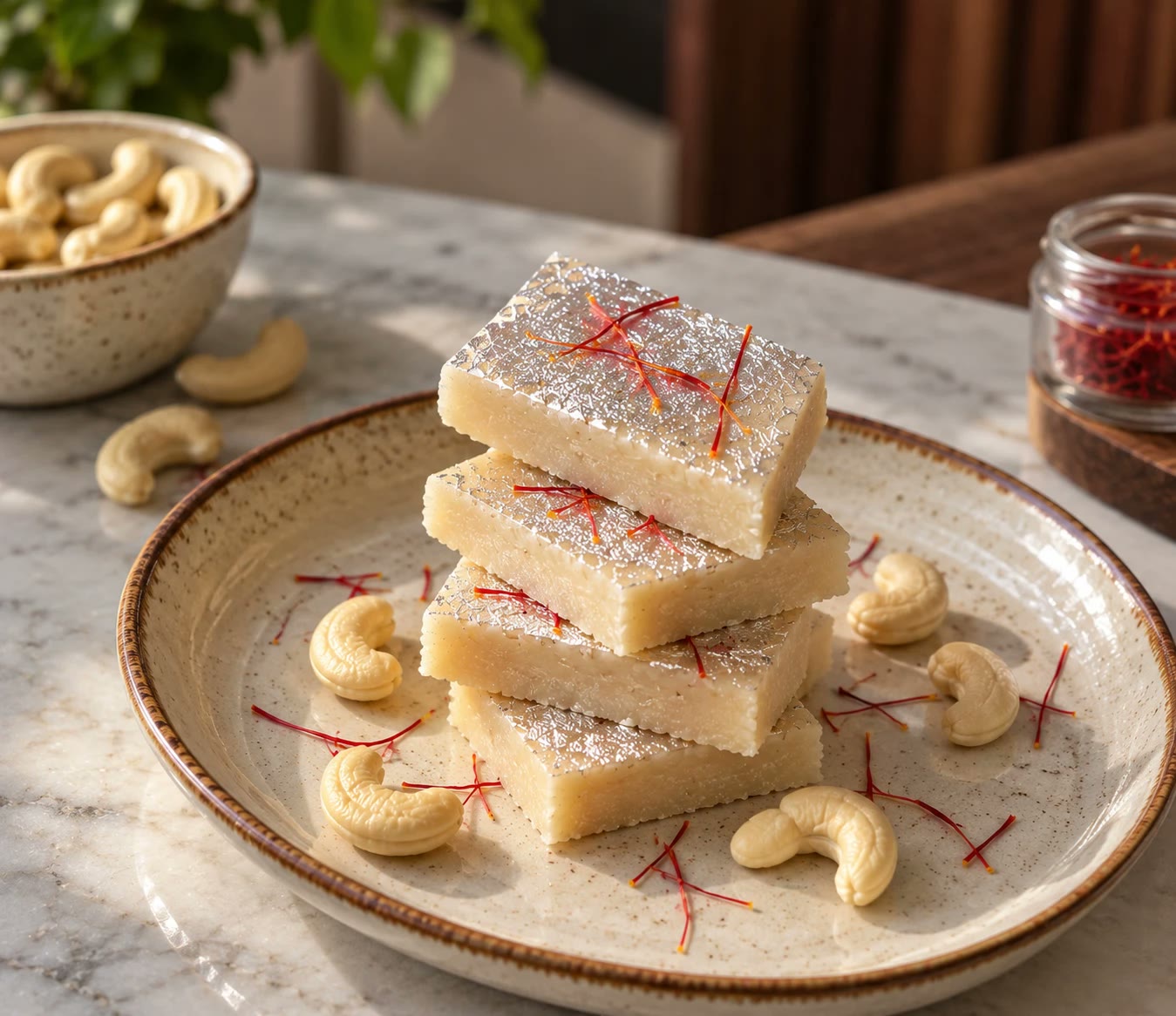
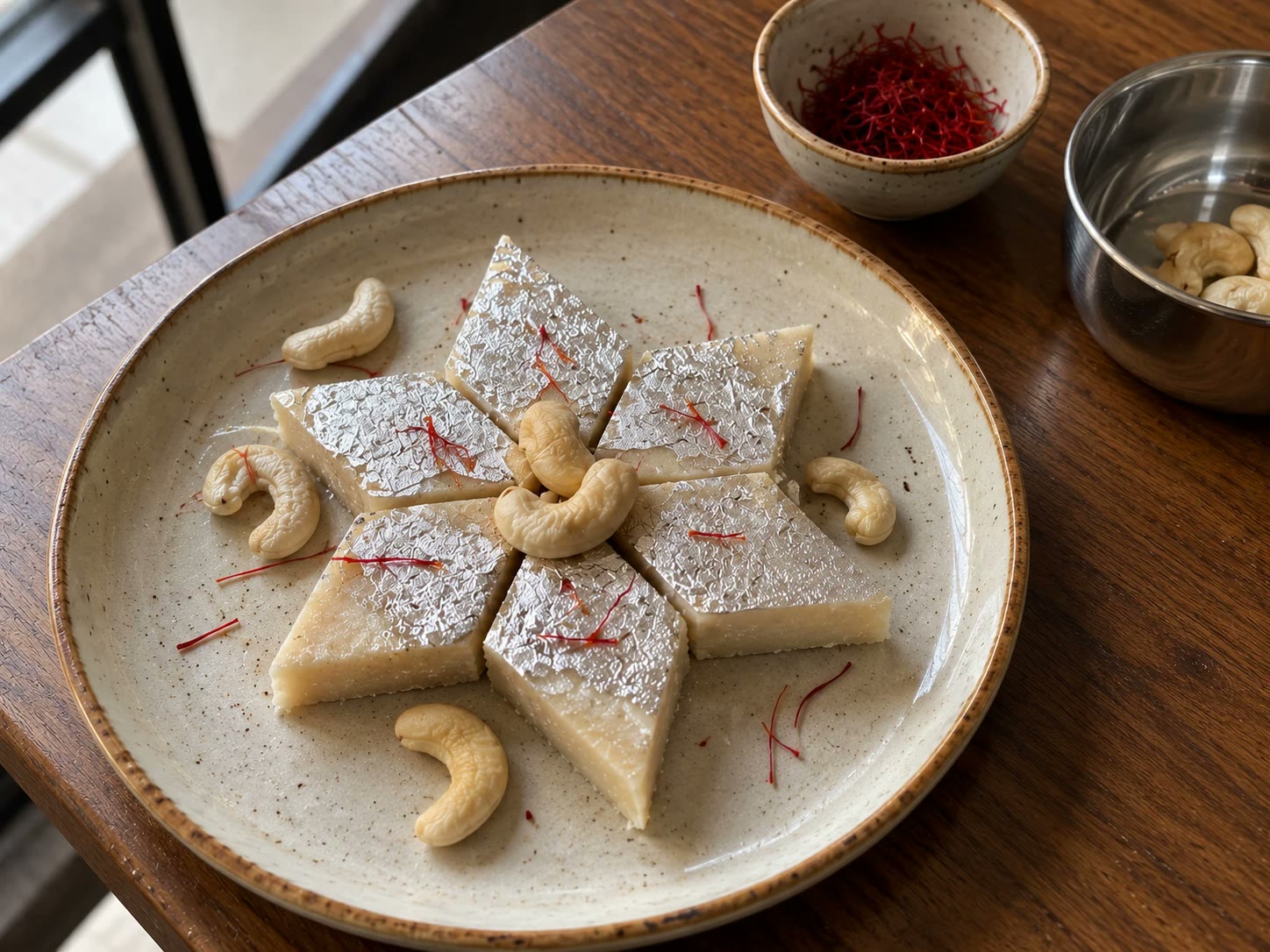
Cashew fudge, if you need the English, though nobody who grew up with it calls it that: a sweet built from two ingredients, cashews and sugar, that is all technique, and the one most people buy because they believe it cannot be made at home. It can, in half an hour of work plus thirty minutes for the pieces to set, and the difference from the shop version is that it tastes of cashew. Everything turns on two moments — the sugar syrup reaching a single thread between finger and thumb, and a minute of kneading while the dough is still warm. Get those right and the silver leaf and saffron on top are the easy part. This is Geeta’s sweet and her photographs; the write-up is Zaika’s, checked against them.
Ingredients
- 200 g raw cashews, whole or pieces, unsalted and unroasted1½ cups raw cashews, whole or pieces, unsalted and unroastedIn the US: Any supermarket’s raw cashews — the big-box bags are fine, and cheaper than the Indian grocery’s. Not roasted and not salted: roasting turns the fudge beige and oily, and there is no rescuing it. Ready-ground cashew flour, sold online, skips the grinding and the risk of cashew butter; check it is made from raw nuts. Superfine blanched almond flour from any US supermarket makes badam katli by the same method, a sweet in its own right.
- 100 g sugar½ cup sugar
- 60 ml water¼ cup water
- 1 tsp ghee, plus a little for greasing1 tsp ghee, plus a little for greasingIn the US: Unsalted butter does the same job. For a vegan katli use refined coconut oil, which does not taste of coconut.
- A pinch of saffron strands, 15 to 20, to finishA pinch of saffron strands, 15 to 20, to finishIn the US: Saffron is a decoration here, not a flavouring, so leave it out rather than reach for turmeric or food colour. A plain ivory top is just as traditional.
- Edible silver leaf (vark), two or three sheets, optionalEdible silver leaf (vark), two or three sheets, optionalIn the US: There is no substitute, and the katli is the same sweet without it. Buy vark (or varq) at an Indian grocer, where it is sold in booklets of tissue-backed sheets, usually near the checkout, and never at a craft shop, where silver leaf is usually aluminium and is not food. Look for pure silver, 99.9%, in a pack that says machine-made: vark was traditionally beaten between layers of animal gut, which is why some vegetarians avoid it. To check a sheet, rub a scrap between finger and thumb. Real silver crumbles to nothing; a sheet that rolls into a small grey ball is aluminium, and the pack should not go on food.
- 12 whole cashews, to decorate12 whole cashews, to decorate
Method
- 1In a warm kitchen, put the cashews in the freezer for fifteen minutes first: cold nuts turn to powder before they turn to butter. Grind them to a fine powder in a small food processor, or in a spice grinder in two or three batches, in short pulses, opening the lid between them to scrape down the sides. Stop the moment it looks like flour: a few seconds more and the oil comes out and you have cashew butter, which makes a greasy katli that never sets. Sieve it, and pulse again whatever stays behind.
- 2Grease a sheet of baking parchment and a rolling pin with ghee and keep them beside the stove with the saffron and the silver leaf. Once the dough comes off the heat it waits for nobody, so nothing should need looking for.
- 3Put the sugar and water in a heavy pan on medium heat and stir until the sugar dissolves, then stop stirring and let it boil. After four or five minutes take a drop on a spoon, let it cool on the spoon for a few seconds — it is hotter than it looks — and pull it between finger and thumb: it should stretch into a single thread before it breaks. Short of that the katli stays soft; well past it and it crumbles. This thread is the whole recipe.6 min
- 4Turn the heat to low and tip in the cashew powder all at once. Stir without stopping — it goes from loose to a thick mass within a minute, then begins to come away from the sides of the pan as one lump. Stir in the ghee. Test by cooling a pea-sized piece on a plate for a few seconds and rolling it between your fingers: a smooth ball that does not stick is done; a sticky smear needs another minute.5 min
- 5Turn the dough out onto the greased parchment and leave it for two or three minutes, until you can bear to touch it. Then knead it with greased palms for a minute, folding and pressing, until it is smooth and the cracks close. Warm is the only time it will do this; cold dough crumbles. The smooth face of finished kaju katli comes from this minute of kneading, not from the rolling.3 min
- 6Fold the parchment over the dough and roll it out to about a centimetre thick; 5 mm gives the thin shop look and closer to three dozen pieces, and needs more silver leaf. For each sheet of silver leaf, lift off the loose top tissue, turn the sheet over onto the katli so the backing paper is on top, press it on lightly through the paper and peel the paper away — the leaf tears the moment a finger touches it. Scatter the saffron strands and press them in.
- 7Cut while it is still slightly warm: parallel lines one way and diagonally the other for diamonds, or straight across both ways for squares. You should have about two dozen at a centimetre thick, and a serving is two pieces. Leave the pieces to set and cool completely before you separate them, and decorate the plate with the whole cashews.30 min
Prefer to cook in Hindi, Tamil, Bengali or another language? Save this into the Zaika app and the method reads in yours.
If it goes wrong
Why your kaju katli is sticky, or crumbles when you cut it
Sticky means the syrup stopped short of the single thread, or the mass came off the heat before it could roll into a clean ball; the fix is to put it back in the pan on low, adding nothing, and stir for another minute or two until a pea-sized piece rolls into a clean ball. Crumbly is the opposite: the syrup went past the thread, or the dough was left to go cold before kneading. A crumbly dough can usually be brought back by kneading in a teaspoon of warm water — water rather than milk, which shortens how long the sweet keeps and makes the vegan version not vegan. Humidity matters more than people expect, because sugar pulls water out of the air — on a wet day cook the mass a minute longer and let the pieces set under a fan rather than on the counter.
Substitutions
Making kaju katli with cashew pieces, without silver leaf, or vegan
Broken cashew pieces are the thing to buy: they are noticeably cheaper than whole nuts and identical once ground, and only the dozen used to decorate the plate need to be whole. The silver leaf is a decoration and nothing else — leave it off and the sweet is unchanged, or press a few pistachio slivers into the top instead. For a vegan katli, swap the teaspoon of ghee for refined coconut oil and grease the parchment with the same; the result is indistinguishable, since ghee is there to keep the dough from sticking rather than for flavour.
Keeping it
How long kaju katli keeps, and whether to refrigerate it
A week in an airtight box at room temperature with parchment between the layers, which is how it travels and how it is gifted. In the fridge it keeps two weeks but turns hard, so take it out twenty minutes before serving. It freezes well for a month, layered the same way; thaw it in the box so the silver leaf does not sweat. Pack it only when the pieces are completely cool — warm katli steams the box and the saffron bleeds.
Make ahead
Kaju katli for Diwali: making it ahead and giving it as a gift
It is the Diwali sweet most often bought and most worth making, because it is at its best within a week and shop boxes are rarely that fresh. Make it up to four days before the day, in two batches rather than one large one — a double quantity of syrup is harder to judge at the thread, and the dough cools faster than you can knead it. For gifting, cut diamonds, let them set overnight and pack them in a single layer with the silver leaf up; a 200 g batch makes about two dozen, enough for two small boxes. Write "cashew" on each box: a tree-nut allergy is the one thing the person you give it to cannot see.
Substitutions
Is kaju katli gluten-free, vegan or nut-free?
Gluten-free as written: cashews, sugar, water and ghee, with no flour and no asafoetida. If you buy ready-ground cashew flour, check the pack for a may-contain warning, since some is milled alongside wheat. It is vegetarian rather than vegan because of the ghee; refined coconut oil in its place, and machine-made vark or none, make it vegan. It is the opposite of nut-free — the whole sweet is cashew, and there is no version without it — so for a guest with a tree-nut allergy, make something else, and keep the knife and board you cut the katli on away from their plate.
Nutrition
Estimated, per serving.
- Calories
- 137
- Protein
- 3 g
- Carbs
- 14 g
- Fat
- 8 g
- Fibre
- 1 g
- Sugar
- 9 g
This recipe is ready for the Zaika app
Step timers on the method, the whole thing readable in your own language, and the ingredients on a grocery list split by the shops you actually use. Zaika is free on iPhone and Android.