Rabri Ghevar
रबड़ी घेवर
By Geeta S · 125 min · serves 8 · Rajasthani
Cook mode, timers and a grocery list — join the Zaika waitlist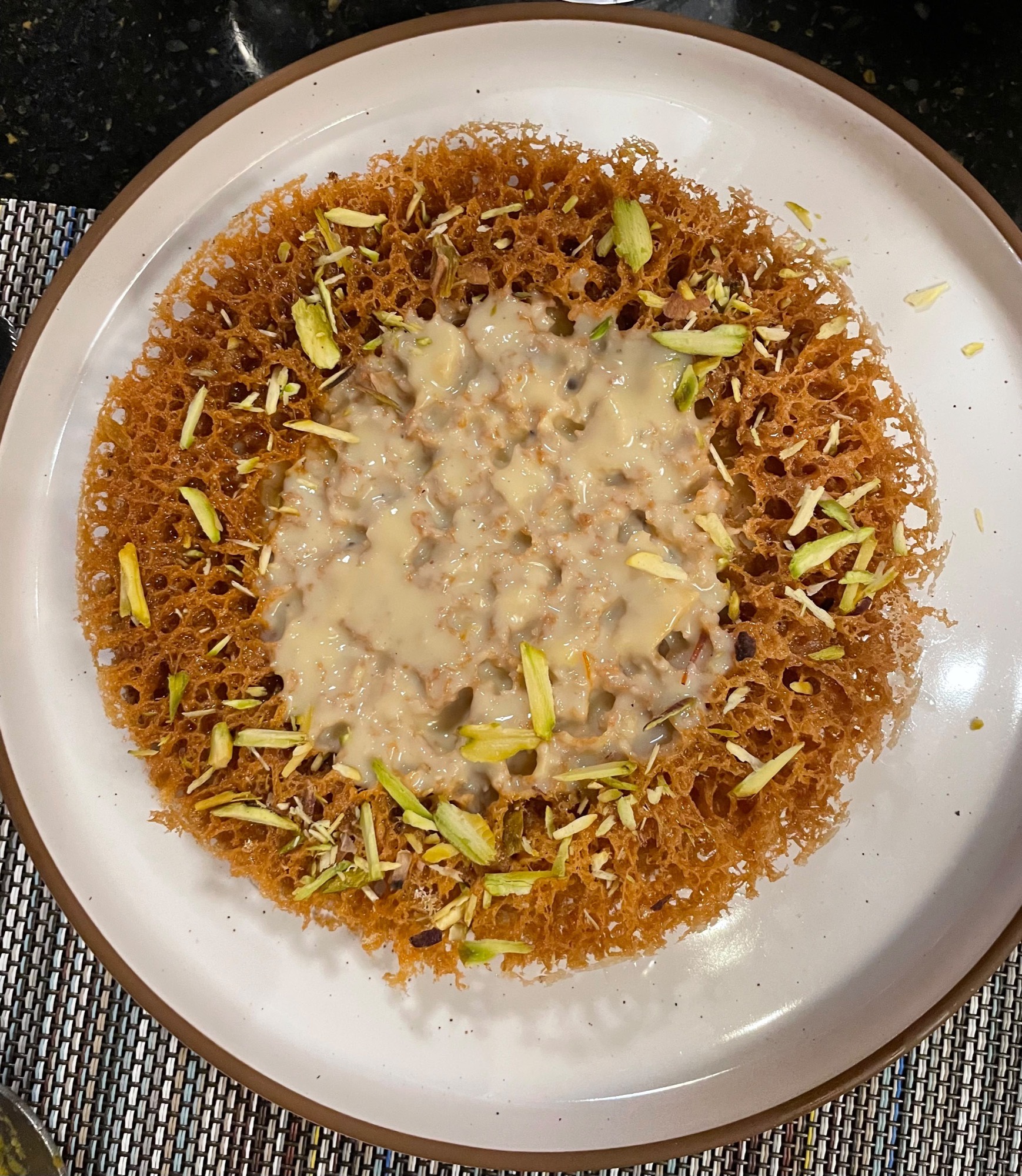
The Rajasthani monsoon sweet that looks impossible and mostly is not — a crisp honeycomb disc soaked in syrup, with thickened milk poured into the well in the middle. Everything rests on one step that has nothing to do with frying: the ghee is beaten with ice until it turns white and creamy, and if you stop early the batter will not lace. Read it through before you start, because once the ghee is hot there is no pausing — and put the rabri on first, since it is an unattended hour that the rest of the recipe fits inside.
Ingredients
- 250 g maida2 cups maidaIn the US: Plain all-purpose flour is the same thing — maida is simply the Indian name for it. Do not use bread flour; the extra gluten makes the lattice chewy instead of brittle.
- 60 g ghee, cold and solid, for the batter¼ cup ghee, cold and solid, for the batterIn the US: This one cannot be swapped. The whole structure comes from beating solid ghee into an emulsion, and oil will not hold air the same way.
- 2 ice cubes, for beating into the ghee2 ice cubes, for beating into the ghee
- 600 ml ice-cold water, plus more to adjust2½ cups ice-cold water, plus more to adjust
- 1 litre ghee or neutral oil, for frying4 cups ghee or neutral oil, for frying
- 300 g sugar, for the syrup1½ cups sugar, for the syrup
- 150 ml water, for the syrup⅔ cup water, for the syrup
- ½ tsp green cardamom, ground½ tsp green cardamom, ground
- 1 litre whole milk, for the rabri4 cups whole milk, for the rabriIn the US: A 400 g tin of evaporated milk simmered with 100 ml whole milk and 40 g sugar gets you a passable rabri in fifteen minutes instead of an hour. It is smoother and less interesting, and on a festival day that is a fair trade.
- 60 g sugar, for the rabri5 tbsp sugar, for the rabri
- 1 pinch saffron strands1 pinch saffron strands
- 30 g pistachios, slivered¼ cup pistachios, slivered
Method
- 1Put the cold ghee and the ice cubes in a wide bowl and beat with your hand or a whisk until the ghee turns pale, creamy and roughly doubles — six or seven minutes. Discard whatever ice has not melted. This is the entire dish; a ghee that is merely soft will fry into a pancake.7 min
- 2Add the flour in three lots and the ice-cold water in between, whisking to a completely smooth batter. It should be thin — it runs off the whisk in an unbroken stream, closer to single cream than to pancake batter. Add more cold water if it ribbons.8 min
- 3Sit the batter bowl inside a larger bowl of iced water and leave it there for the whole of the frying. A batter that warms up stops making holes, and this is the most common reason a second ghevar comes out worse than the first.
- 4Heat the frying ghee in a tall, narrow, straight-sided pot — about 15 cm across and at least 20 cm deep — until it is properly hot: a drop of batter should surface and sizzle hard within a second or two. The ghee must come no more than HALFWAY up. Each ladle foams to roughly three times its volume, and a pot filled higher than half will send boiling ghee over the rim.10 min
- 5Pour one ladle of batter in a thin steady stream from about a foot above, straight into the centre. It will erupt into foam. Stand back, and wait for the foam to fall before you do anything else — about thirty seconds.
- 6Keep pouring into the same central spot, one ladle at a time, waiting for the foam to drop between each. After eight to twelve pours you will have a lattice reaching the sides. Open the middle with a skewer as it sets so the well stays clear.12 min
- 7When the bubbling slows and the disc is deep golden, slide a long skewer through the middle and lift it just clear of the surface, holding it there until the ghee stops running off — it is fragile and heavy with fat, and moving it across the kitchen too early is how it breaks and how you get burnt. Then rest it hole-side down on a rack over a tray for twenty minutes; it crisps as it cools.20 min
- 8For the syrup, boil the sugar and water with the cardamom to one-string consistency. Test it by dropping a little onto a cold plate and leaving it ten seconds — then press it between finger and thumb, and it should pull a single thread as they part. Do not test it straight from the pan; sugar syrup at that temperature sticks to skin and keeps burning.12 min
- 9For the rabri, bring the milk to a boil in a wide pan and reduce it on medium, scraping the skin back in every few minutes, until it is a third of what you started with and visibly thick. Stir in the sugar and saffron and cool.60 min
- 10Ladle the warm syrup evenly over the ghevar and let it soak for a minute, then lift it back onto the rack to shed what it does not hold. Too long in the syrup and the honeycomb softens into cake.
- 11Spoon the cooled rabri into the centre well only, leaving the outer ring bare so it stays crisp. Scatter pistachios over both the rabri and the lattice, and serve within a couple of hours.
Prefer to cook in Hindi, Tamil, Bengali or another language? Save this into the Zaika app and the method reads in yours.
If it goes wrong
Why your ghevar came out flat instead of lacy
Four causes, in the order they are usually to blame. The ghee was not beaten long enough — it has to go visibly pale and creamy, not just soft. The batter was too thick, so it sank instead of spreading; it should be thin enough to pour in a stream. The batter warmed up, which is why it sits over ice. Or the frying ghee was not hot enough, so the batter sank and set before the water in it could flash to steam — and it is that steam, escaping upward, that punches the holes.
Equipment
Making ghevar without a ghevar mould
Depth matters far more than the mould does. What you need is a pot narrow enough that a single ladle of batter reaches the sides, and deep enough that it can foam to three times its volume without going over the rim — a tall saucepan or a small stockpot works. A wide kadhai is the one thing that will not: the batter spreads too thin and you get lace with no structure. Whatever you use, the diameter of the pot is the diameter of your ghevar.
Make ahead
Why the rabri goes on at the last minute, not before
The plain syrup-soaked disc keeps for four or five days in a tin at room temperature, and it is genuinely better made a day ahead — it firms up. Rabri on top starts softening it within a couple of hours, from the middle outward. So make both in advance if you like, keep them apart, and assemble when people are ready to eat. This is also why the outer ring is left bare in the photograph.
Serving
When ghevar is eaten, and why it is a monsoon sweet
It belongs to Shravan — Teej and Raksha Bandhan above all — when it appears in every sweet shop in Rajasthan and across Delhi and stops being sold soon after. The usual explanation is practical rather than religious: the batter behaves best in damp, cooler air, and the same humidity that makes it easy to fry makes it go soft quickly, so it was a sweet you made and ate in the season rather than kept.
Nutrition
Estimated, per serving.
- Calories
- 480
- Protein
- 8 g
- Carbs
- 60 g
- Fat
- 23 g
- Sugar
- 42 g
This recipe was written for the Zaika app
Step timers on the method, the whole thing readable in your own language, and the ingredients on a grocery list split by the shops you actually use. It is not out yet — join the waitlist and we will email you once, when it is real.
Join the waitlist →